Tallo: Helping Career Starters Find Jobs Worth Applying To
How Tallo turned research on career starters into a Career Scorecard and job recommendations grounded in real career moves, and what iterating taught us.
"I need to know what jobs are worth applying to."
That sentence came out of a design kickoff at Tallo in October 2025, and it became the brief for a year of work. Tallo's Career Starters – people heading into the workforce without a college degree – were finding job listings through Google, and a job listing on its own gave them no more reason to stay than the same listing on Indeed.
Over the following year, that sentence turned into two features: a Career Scorecard that helps a career starter decide whether a job is worth their time, and job recommendations that point them toward better ones. Neither ended up exactly where it started, and both are better for it.
The research pointed at two questions
This work grew out of the Strategy engagement with Tallo, which identified 15 problems Career Starters face. The top two shaped everything here: which jobs are worth pursuing, and what should my next step be.
The research on this generation explains why those questions are so hard to answer alone. Young job seekers do a lot of their career research on TikTok and Reddit, and the sheer volume of it overwhelms them. They're more likely than older generations to fall for job scams, so many have learned to treat every opportunity with suspicion, which means they also pass over good ones.
They didn't need more job listings. They needed someone to do the interpretation work for them, in a way they could trust.
Building the scorecard
The first version put a scorecard on every job detail page. We built it around the questions a career starter is actually asking – will this pay enough to live on, will the pay grow, and is the field stable – and started with two scores, pay growth and job security. Each comes with a plain-language read, like "Moderate demand, field is stable but pay varies," and a link explaining exactly how it's calculated.
Moving from the job to the career
As we watched people use it, the scorecard changed shape. The Job Scorecard became the Career Scorecard, presented as Career Insights for the career a job belongs to: what people in that career actually do, median pay in the learner's state, projected growth, and the pay growth and job security scores alongside.
That change did two things. It put the score at the level where the data is strongest, so the scorecard says what the evidence supports and nothing more. And it gave learners somewhere to go next. Someone looking at one job can add the career to their goals or click through to explore it in depth, which turns a single listing into a step on a longer path.
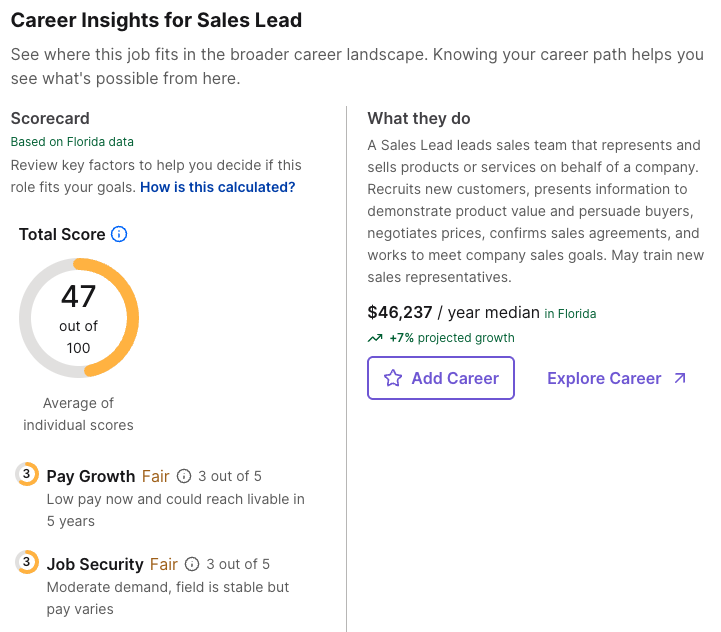
We were careful about tone, too. An anxious 19-year-old doesn't need a list of everything they're missing. The scorecard is written to help them weigh a decision, and the rest of the experience follows the same idea: you're on a journey, and Tallo is going with you.
Recommendations built on real career moves
A scorecard answers "is this job worth it?" When the answer is "not really," the next question is "then what is?"
We didn't want to answer that with an algorithm's best guess. Tallo partnered with Opportunity@Work, whose Skills Mobility Data Model maps the moves millions of U.S. workers have actually made, including tens of millions of workers Skilled Through Alternative Routes – people who built their skills through work and training rather than a four-year degree. That's very close to Tallo's audience. For people who distrust nearly everything, "workers with skills like yours made this move" is a much stronger claim than "we think you'd like this."
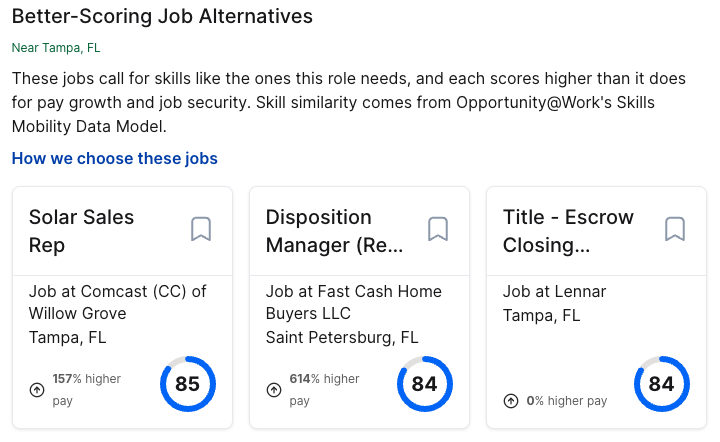
The recommendations build directly on the scorecard. On a job page, Tallo shows nearby jobs that call for similar skills and score higher on pay growth and job security, along with how much more each one pays.
What iterating taught us
The first version of the recommendations didn't land the way we wanted, and the reasons turned out to be useful. Each round followed the same loop – research the problem, ship the smallest version that answers it, measure what people actually do, and change it when the evidence says to – and a few principles came out of it that apply well beyond Tallo:
- Relevance comes first. A recommendation has to look right at a glance, or nobody clicks, and the quality of what's behind the click never gets a chance to matter.
- "Better" has to be specific. A recommendation should say exactly how a job is better, in terms the learner can check for themselves, like how much more it pays.
- A better job has to be reachable. A better job you can't get isn't a recommendation, it's a taunt.
- Explanations don't build trust by themselves. Clear methodology pages matter for transparency, but career starters mostly want the guidance to feel right. The recommendation itself has to earn that.
The idea underneath both features
Plenty of good careers are invisible from where a career starter is standing. A scorecard can tell them whether the job in front of them is worth their time, and real transition data can show them the jobs their skills already reach, including stepping-stone roles they'd never have thought to look for.
That was the point of the sentence we started with in October 2025. Tallo didn't need to be one more place to find job listings. It needed to help a career starter see which jobs were worth their time and where they could go next.
Most career starters are closer to a better job than they think. The work is helping them see it.
Frequently Asked Questions
What is Tallo's Career Scorecard?
It's a section on Tallo's job pages that rates the career a job belongs to on pay growth and job security, alongside what people in that career do, median pay in the learner's state, and projected growth. Learners can add the career to their goals or click through to explore it in depth.
Why rate the career instead of the individual job?
Career-level data is where the evidence is strongest, and a career starter's real question is usually where a job leads, not just what it pays today. Rating the career keeps the score accurate and gives the learner a next step.
Where do Tallo's job recommendations come from?
From Opportunity@Work's Skills Mobility Data Model, which maps the career moves millions of U.S. workers have actually made, including workers Skilled Through Alternative Routes (STARs). Tallo uses it to suggest nearby jobs that call for similar skills and score higher on pay growth and job security.
What makes a job recommendation trustworthy for career starters?
It has to look relevant at a glance, be reachable from where the learner is now, and be specific about why it's better – how much more it pays, and evidence that real people have made the move. Explanations help, but the recommendation itself has to feel right first.
Was this part of the Strategy engagement?
It grew out of it. The Strategy stage identified the problems career starters face, and this is what building against two of them looked like over the following year – shipping, measuring, and improving based on what we learned. That ongoing execution work is typically a separate engagement.
More Case Studies
- Tallo: From Months of Debate to a Shipping Roadmap – the Strategy engagement this work grew out of
- Stride: 3x Productivity in 90 Days – the engagement I ran for Tallo's parent company three years earlier
Want This Kind of Follow-Through?
The Strategy stage of The Fieldway System gives your team a validated direction. Staying on through execution means someone is there to measure what you ship and help decide what to change next.
Book a discovery call, or email matthew@fieldway.org.
Ready for similar results?
Tell me the question you're trying to answer, and we'll find the right place to start.
Book a Call